Open the linen chest in an old farmhouse in Umbria and you will still find towels with hand-worked hems, a christening gown, a length of hemp someone's grandmother bleached in the sun. Italy's textile life did not stop when the mills modernised. It folded itself into wardrobes and sacristies and shoe boxes, and eventually into galleries. The distance between a treadle loom in the Biella hills and a white-walled exhibition in Milan is shorter than it looks.
What follows is a working map of that route: the places that made the cloth, the workshop culture that shaped it, the moment thread became a medium rather than a furnishing, and the practical questions worth asking before you hang a textile on your own wall.
A Peninsula Built on Cloth
Italy's textile geography follows water and sheep. In the north, Biella's wool mills grew up along the Cervo river, whose soft water suited dyeing and washing fleece; the city still reads as a company town, with chimneys and factory gates set among alpine foothills. East of Milan, Como built its fortune on silk, using the lake's clear water to degum and finish yarn, and it remains the reference point for printed silk in Europe.
Prato took a different route. For well over a century its workshops have been fed by rags — sorted, shredded and re-spun into new wool, a trade so ingrained that the cenciaioli, the rag sorters, became a local archetype. Florence had its silk guilds and, from 1545, a Medici tapestry workshop. Naples had San Leucio, the Bourbon silk colony laid out as a model industrial village. And the south and the islands kept older habits: linen and hemp in Puglia and Basilicata, and in Sardinia a weaving tradition — Aggius, Nule, Isili — that still works on horizontal looms and treats pattern as something close to a family signature.
Inside the Bottega
For centuries the loom was a workplace, a school and a social register at once. Guilds such as Florence's Arte della Lana and Arte della Seta set standards for yarn, dyes and finished widths, and they protected their members fiercely. Training started early. A boy might sweep, wind bobbins and learn to read a draft before he was allowed near the heddles.
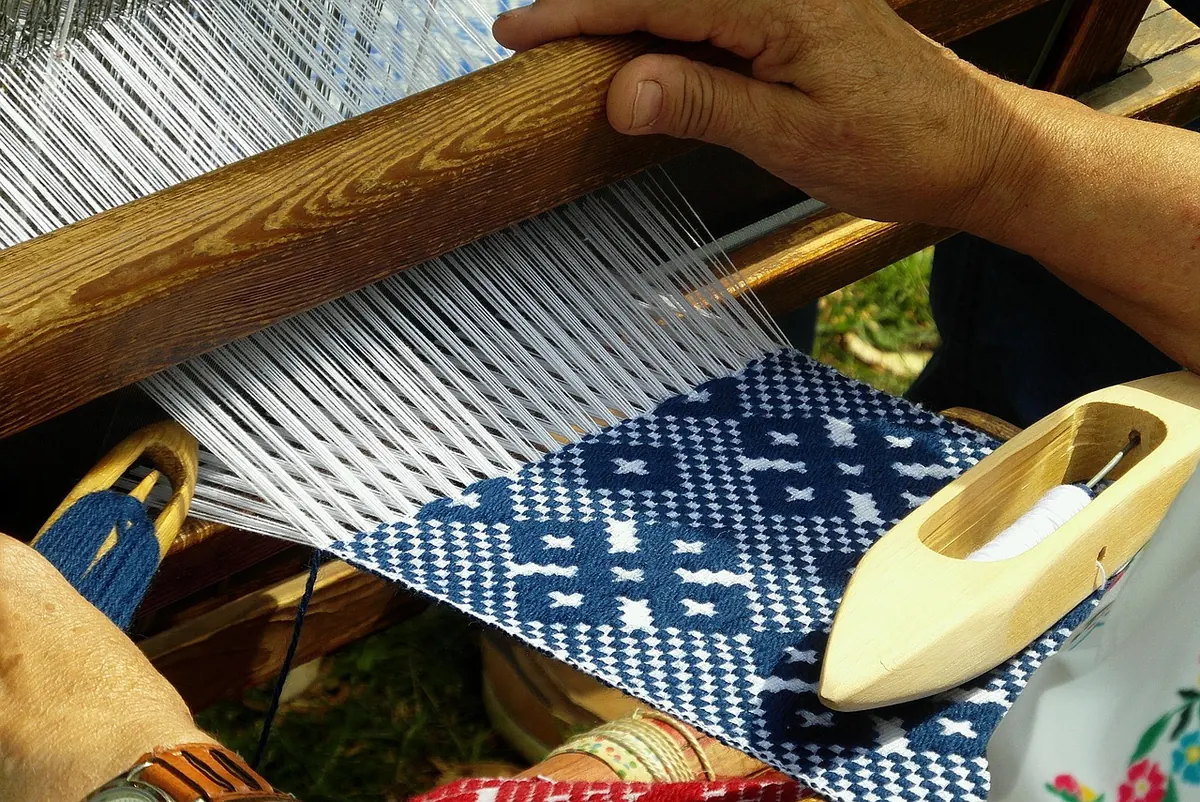
The vocabulary survives, and it is worth knowing if you plan to talk to a weaver. Ordito is the warp, the tensioned threads that carry the structure. Trama is the weft, the thread passed across. Licci are the heddles that lift and lower the warp; the pettine, or reed, beats each pass of weft into place. Tela, in Italian, means both cloth and canvas — a small reminder that until quite recently the two were the same thing.
Tapestry pulled artists into the workshop. Bronzino drew cartoons for the Medici looms, and the resulting hangings were collaborative objects: painter, cartoonist, dyer, weaver, finisher. That habit of collaboration never disappeared; it just changed employers.
When Thread Became a Medium
Fortunato Depero applied Futurist geometry to textiles and tapestries in the 1920s, treating pattern as a place to test ideas rather than decorate a sofa. But the decisive shift came after the war, and especially in the 1960s, when the Lausanne tapestry biennials — running from 1962 into the 1990s — pushed weavers to stop enlarging someone else's painting and start making their own work. Fiber art grew out of that argument, and Italian artists joined it on their own terms.
Three examples show how differently it went.
- Alighiero Boetti turned embroidery into a conceptual practice. From the early 1970s he had maps and phrases stitched by Afghan craftswomen, first in Kabul and later in Pakistan, so that the piece became a record of a long-distance collaboration as much as an image.
- Marisa Merz knitted and crocheted copper wire in the 1960s, making a "living sculpture" that hung in a room like something halfway between a hammock and a nerve. Same gestures as domestic craft, entirely different intent.
- Maria Lai, working from the Sardinian village of Ulassai, sewed words and drawings into cloth as a way of writing. In 1981 she tied thousands of ribbons between the houses of her village, an act that turned the whole town into a textile — and made the case, better than any manifesto, that thread can hold a community together.
The Studio Today
Walk into a contemporary Italian textile studio and you are as likely to find a sewing machine, a dye pot and a stack of salvaged linen as a floor loom. The current generation works with walnut husks and madder root, with deadstock from Prato's mills, with digital jacquard files sent to a mill in the morning. Embroidery is used as drawing. Patchwork becomes a way of organising memory. Soft objects lean against walls or lie on the floor and ask to be walked around.
Chiara Camoni's fabric-and-ceramic assemblages are a good entry point: recognisably made by hand, openly domestic in their materials, and yet entirely at home in a gallery. The border between design and art stays porous here, which is part of the appeal. A fabric developed for a fashion house can reappear as an artwork; a hand-woven velvet from a Florentine foundation can sit beside a student's first sampler. Dealers will tell you that fibre still sells for less than a painting of comparable seriousness — which, if you are collecting, is not bad news.
Where to See It
A short field guide, useful for a weekend or a longer trip:
- Prato, Museo del Tessuto. Housed in a former mill, strong on the industrial story and increasingly on contemporary work. Pair it with a walk past the workshops that still recycle yarn.
- Como, silk collections. Museum displays on silk production, dyeing and printing, plus the district's design history. Best visited with a notebook.
- Florence, Fondazione Arte della Seta Lisio. Hand-looms still producing velvet and damask. Seeing a drawloom work explains more about textiles than any wall label.
- Florence, the Medici tapestry workshop. The historic Arazzeria continues restoration and weaving; visits usually need to be arranged in advance.
- Biella. Wool heritage, mill architecture, and Cittadellarte, the Pistoletto foundation, for the contemporary side of the same story.
- Isili, Sardinia. A permanent textile collection devoted to island weaving, with the pattern traditions of towns like Aggius and Nule nearby.
Before You Buy or Hang a Textile
A few practical habits will save you money and regret.
- Look at the reverse. The back of a piece tells you how it was made: knots, floats, whether the ends are finished or merely cut. It is the closest thing to a maker's signature.
- Ask about materials and techniques. Natural or synthetic dye, hand or power loom, wool, linen, silk or viscose. None of these answers is automatically better; each tells you how the piece will age.
- Plan the light. Silk and dyed wool fade. Keep work out of direct sun, and rotate pieces that hang in bright rooms.
- Hang it properly. Sew the piece to a linen-covered board rather than stapling or pinning it; the weight should be spread, not concentrated at a few points.
- Do not wash a fragile or antique textile. For anything valuable or old, ask a textile conservator before you touch it with water.
- Buy small, buy local. A modest piece bought directly from a weaver you have met teaches you more than a large one bought at auction.
The thread between an Italian loom and a gallery wall is not a break with tradition. It is the same skill, used for a different purpose — which is why the most interesting rooms in the country are often the ones where a shuttle and a spotlight share the space.
Photo: Nowaja / Pixabay